How to Become a Dental Hygienist (Steps, Skills and Pay)
A look at the chairside work, the CODA-accredited associate degree route, the board and clinical exams, and the state license checks that decide where you work.
By Marcus Lee · Oct 15, 2026 · 13 min read
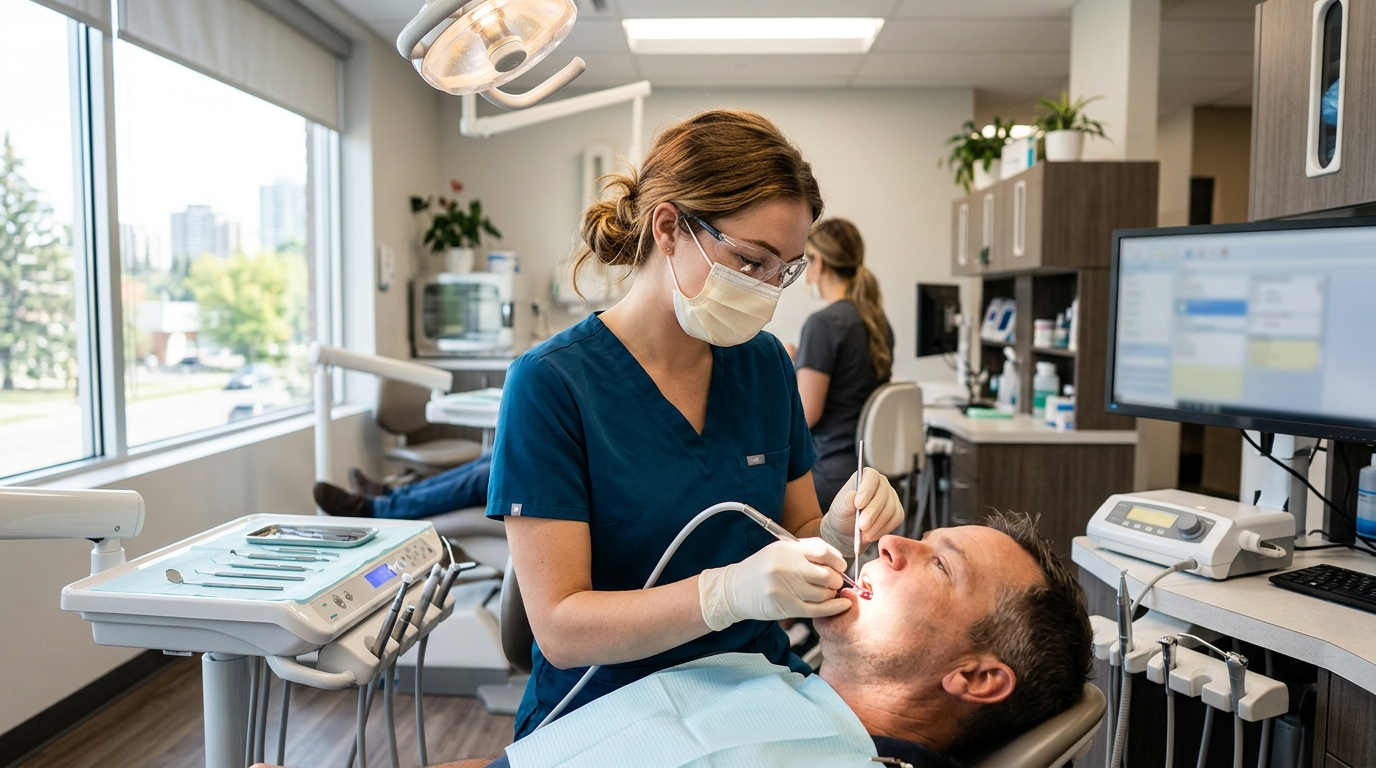
To become a dental hygienist you complete a dental hygiene program accredited by the Commission on Dental Accreditation (CODA), pass a written national board exam and a clinical exam, and then get licensed by the state you want to work in. Hygienists typically need an associate's degree, and programs usually take about three years to complete (U.S. Bureau of Labor Statistics, 2026-08-27).
Every state requires a license, and the specific requirements vary by state (U.S. Bureau of Labor Statistics, 2026-08-27), so the route you follow depends on where you plan to practice.
What a dental hygienist does (list)
You spend most of the day with one patient at a time, in a chair, doing hands-on clinical work and talking while you do it. Typical duties include (U.S. Bureau of Labor Statistics, 2026-08-27):
- Removing tartar, stains and plaque from teeth, using hand instruments, power and ultrasonic tools, and sometimes lasers.
- Applying sealants and fluorides to help protect teeth.
- Taking and developing dental x-rays using the practice's x-ray machines.
- Assessing a patient's oral health, including screening and periodontal charting, and reporting what you find to the dentist.
- Documenting care and treatment plans in the patient record.
- Educating patients on brushing, flossing and other oral hygiene techniques, including after a procedure.
- Polishing teeth with a power tool or an air-polishing device to remove stains.
Where you work. Overwhelmingly, in a dentist's office: 94% of dental hygienists were employed in offices of dentists in 2025 (U.S. Bureau of Labor Statistics, 2026-08-27). Smaller numbers work in settings such as public health programs, schools and clinics, and what you are allowed to do without a dentist on site depends on your state's scope-of-practice rules.
A typical schedule. Most clinical days are built around appointment slots — often 40 to 60 minutes per adult recall patient — with a short turnaround to disinfect the operatory and set up for the next person. Many dental hygienists work part time, because dentists may hire a hygienist for only a few days a week, so some hygienists work for more than one dentist (U.S. Bureau of Labor Statistics, 2026-08-27). That is the honest shape of the job: a four-day or three-day week at one practice is common, and building a full-time income can mean holding two part-time posts with different software, different charting habits and different commutes.
The other thing nobody mentions at open days is the physical load. You lean, you grip, you repeat the same wrist motions all day, and neck, shoulder and hand problems are a real reason hygienists cut back their days or leave chairside work. Loupes, good positioning and sharp instruments matter more to your career length than they sound like they should.
How to become one (steps)
- Take biology, chemistry and math in high school, and knock out college prerequisites. High school students interested in dental hygiene should take biology, chemistry and math, and most dental hygiene programs also require applicants to complete prerequisites, often including college-level courses, with specific requirements varying by school (U.S. Bureau of Labor Statistics, 2026-08-27). Time: one to two semesters of prerequisites if you are coming in as an adult. Cost: community college per-credit rates are the cheapest route — ask the admissions office for the current per-credit figure in writing.
- Pick a program accredited by the Commission on Dental Accreditation (CODA). CODA is the specialized accrediting body recognized by the U.S. Department of Education, and it has accredited more than 1,400 programs across predoctoral, allied and advanced dental education (W.K. Kellogg Foundation, sourcing CODA). Accreditation is not a nice-to-have — eligibility for the national board exam depends on it. Time: a few weeks of comparison. Cost: application fees per school.
- Apply, and treat admissions as competitive. Assemble transcripts, prerequisite grades, any required entrance test, and shadowing or dental-assisting hours if the program asks for them. Talk to the program director or a current student before you commit. Time: one application cycle, often six to twelve months ahead of a fall start. Cost: application and testing fees; the spread depends on how many programs you apply to.
- Complete the dental hygiene program. Programs usually take 3 years to complete (U.S. Bureau of Labor Statistics, 2026-08-27). You will scale on manikins before patients, build a patient caseload in the school clinic, and be checked off on radiography, local anesthesia where your state permits it, and periodontal instrumentation. Cost: the single biggest spend, and it varies enormously — in-district community college tuition sits at the bottom, private university programs at the top, plus an instrument kit, loupes, scrubs and clinic fees. Get the full program cost sheet, not just tuition, before you sign.
- Sit the National Board Dental Hygiene Examination (NBDHE). It is administered by the Joint Commission on National Dental Examinations and has 350 multiple-choice questions in two components: 200 on scientific basis, clinical services and community health, and 150 on 12 to 15 dental hygiene patient cases (Pennsylvania College of Technology Library, citing JCNDE). You must be a student in good standing in a CODA-accredited program, or a graduate of one, or a graduate of a non-accredited program with a letter of recommendation from an accredited dean or director and the secretary of a board of dentistry (Mometrix, citing JCNDE eligibility rules). Time: eight to sixteen weeks of structured revision alongside clinic. Cost: the current exam fee from JCNDE, plus any review course or question bank you choose.
- Book and pass a clinical licensure examination. Regional and state clinical exams are administered by testing agencies including CDCA-WREB-CITA, which administers the ADEX exam, the Central Regional Dental Testing Service (CRDTS) and State Resources for Testing and Assessments (SRTA) (American Dental Hygienists' Association, July 2024). Check which exam your intended state accepts before you book — this is the step people get wrong. Time: usually taken in the final term, with results in weeks. Cost: exam fee plus travel and, in some formats, a patient or simulation fee.
- Get CPR certification and keep the card current. Many jobs also require cardiopulmonary resuscitation certification (U.S. Bureau of Labor Statistics, 2026-08-27), and programs often require it before clinic. Time: a one-day course. Cost: low, typically the smallest line on this list; renewal is usually every two years.
- Apply to your state board for licensure, then start job hunting. In most states, a degree from an accredited dental hygiene program plus passing written and clinical examinations are required for licensure, and hygienists must complete continuing education to keep it (U.S. Bureau of Labor Statistics, 2026-08-27). Licensure is the responsibility of the individual state, district or jurisdiction, and requirements vary among them (Department of Defense COOL, citing JCNDE). Information on state licensing board requirements is available from CareerOneStop (U.S. Bureau of Labor Statistics, 2026-08-27). Time: a few weeks to a few months for background checks, jurisprudence exams and processing, depending on the state. Cost: application and license fees set by the board.
Skills you'll need (list)
Hard skills
- Instrumentation. Confident use of hand, power and ultrasonic tools, plus air-polishing devices, polishing handpieces and, in some practices, lasers (U.S. Bureau of Labor Statistics, 2026-08-27). Sharpening your own curettes and scalers is part of this.
- Dental radiography. Taking and developing x-rays, positioning receptors, limiting retakes and recognising when an image is diagnostic. Radiography permits and rules differ by state.
- Periodontal assessment and charting. Six-point probing, recession and furcation recording, and explaining what the numbers mean to the dentist and to the patient.
- Practice and imaging software. Expect to work in dental intra-oral imaging software, dental office management software, voice-activated perio charting software, and systems such as Open Dental or Patterson EagleSoft (O*NET-sourced data via Texas Career Check). Naming the systems you have used on your resume saves an employer training time.
- Infection control and operatory turnover. Sterilisation cycles, barrier technique and documentation, done fast enough to keep the schedule.
- Clinical documentation. Writing notes and treatment plans that stand up later (U.S. Bureau of Labor Statistics, 2026-08-27).
Soft skills — important qualities for the role include critical thinking, communication, being detail oriented, dexterity, interpersonal skills and problem solving (U.S. Bureau of Labor Statistics, 2026-08-27).
- Dexterity. Show it in a working interview: the practice will usually watch you scale a patient. Keep your instruments sharp and your fulcrum steady.
- Communication. Show it by explaining a finding in one plain sentence, then checking the patient understood. In interviews, describe how you handle a patient who refuses x-rays.
- Detail orientation. Show it with clean, specific chart notes and by catching the thing that changed since the last recall.
- Interpersonal skill. Show it by naming how you handle anxious or late patients, and how you work with a dentist whose diagnosis you want to query.
- Critical thinking and problem solving. Show it with a short example: a patient whose home care story did not match the tissue, and what you did next.
Pay and outlook (prose)
Pay for dental hygienists is usually structured hourly or as a flat daily rate for a booked clinical day, rather than an annual salary, because many hygienists work part time — dentists may hire a hygienist for only a few days a week, so some hygienists work for more than one dentist (U.S. Bureau of Labor Statistics, 2026-08-27). Some offices add a bonus tied to production or to hitting a daily target; others pay a straight rate. Read the offer carefully: a strong day rate with no paid holiday, no sick leave and no guaranteed days is a different proposition from a slightly lower rate on a salaried four-day contract.
What moves the number most is geography and employer. Rates differ sharply between states and between metro and rural areas within the same state, and a group practice, a corporate-backed office, a community clinic and a solo dentist will each structure the job differently. Your state's scope of practice matters too: where hygienists may administer local anesthesia, place restorations under supervision, or practice with less direct supervision in public health settings, the role carries more responsibility and the market tends to reflect it. Temporary and per-diem work, often booked through staffing apps or agencies, usually pays a higher headline rate and carries no benefits. Experience helps, but less steeply than in many fields — a hygienist's rate tends to plateau and then move with the local market rather than with seniority.
On demand: employment of dental hygienists is projected to grow 8 percent from 2025 to 2035, much faster than the average for all occupations, with about 15,000 openings projected each year on average, many arising from workers transferring to other occupations or retiring (U.S. Bureau of Labor Statistics, 2026-08-27). Demand for dental services is expected to increase as the older adult population grows and as people keep more of their original teeth (U.S. Bureau of Labor Statistics, 2026-08-27). That does not mean every local market is short of hygienists — areas with several training programs nearby can be crowded, while rural practices often struggle to fill a chair.
For current pay figures and the latest projections, check the dental hygienists page of the Occupational Outlook Handbook published by the U.S. Bureau of Labor Statistics, which also breaks pay down by industry and state. For licensing requirements in the state you want to work in, CareerOneStop lists state dental hygiene licensing board information (U.S. Bureau of Labor Statistics, 2026-08-27). For a realistic local rate, ask two or three hygienists working in your area and a dental staffing agency what a day currently books for.
Career path (timeline)
Dental hygiene is a flat career in the best sense: you reach full clinical competence quickly and then choose how to widen it. Reported job titles include Dental Hygienist, Hygienist, Licensed Dental Hygienist, Pediatric Dental Hygienist and Registered Dental Hygienist, or RDH (O*NET OnLine, 2026).
| Stage | Typical titles | Usual time at this stage |
|---|---|---|
| Entry | Dental Hygienist, Registered Dental Hygienist (RDH), Licensed Dental Hygienist | Years 0-2 |
| Mid | RDH with a full recall column, Pediatric Dental Hygienist, periodontal-focused hygienist, temp or per-diem hygienist across several offices | Years 2-7 |
| Senior | Lead or clinical hygienist, hygiene coordinator, public health or school program hygienist, clinical instructor, clinical educator for a dental products company | Year 7 onwards |
Years 0-2. You build speed. New graduates often need the full appointment and then some; by the end of year one most hygienists are running a schedule without the dentist waiting on them. Expect to start part time or as a temp while you find a practice that fits, and expect to learn a second practice management system.
Years 2-7. You specialise by patient type rather than by title — periodontal therapy, children, medically complex or anxious patients. Some hygienists take on extra duties their state permits, such as local anesthesia or expanded functions, which usually means a short course plus a board permit. Others build a portfolio of two or three regular offices, which gives control over your week at the cost of security.
Year 7 onwards. Routes out of or alongside the chair include leading a hygiene department, coordinating recall and clinical standards, public health and school-based programs, product sales and clinical education, and teaching in a dental hygiene program. Teaching and public health roles frequently require a bachelor's or master's degree in dental hygiene or a related field, and entry requirements vary by employer and by state, so check the specific posting rather than assuming. Whatever route you take, maintaining licensure means completing continuing education, with the hours and topics set by your state board (U.S. Bureau of Labor Statistics, 2026-08-27).
Frequently asked questions
Do I need a degree to become a dental hygienist?
Yes. Dental hygienists typically need an associate's degree in dental hygiene (U.S. Bureau of Labor Statistics, 2026-08-27), and the program must be accredited by the Commission on Dental Accreditation if you want a straightforward path to the national board exam — eligibility normally requires you to be a student in good standing in, or a graduate of, a CODA-accredited program (Mometrix, citing JCNDE eligibility rules). Bachelor's and master's degrees in dental hygiene exist and matter mainly for teaching, research, public health and some administrative roles, not for routine chairside work.
How long does it take from a standing start?
Dental hygiene programs usually take 3 years to complete (U.S. Bureau of Labor Statistics, 2026-08-27), and that is before you add prerequisite coursework if you have not done it, which can take one to two semesters. After graduation, allow a few weeks to a few months for the National Board Dental Hygiene Examination, a clinical licensure exam and state license processing. The spread depends on how often your state's accepted clinical exam is offered, how quickly the board processes applications and whether you need a jurisprudence exam or background check.
Can any of this be done remotely?
The job itself cannot. Scaling, radiographs and sealant placement all happen chairside, and 94% of dental hygienists were employed in offices of dentists in 2025 (U.S. Bureau of Labor Statistics, 2026-08-27). Some didactic coursework may be delivered online depending on the program, but clinical hours are in person and attendance is tightly tracked. Later in your career, roles in education, insurance review, teledentistry support and product education can involve remote or hybrid work, and what is permitted varies by state.
Can I move my license to another state?
Licensure is the responsibility of the individual state, district or jurisdiction, and requirements vary among them, though all require applicants to meet education requirements and pass a written and a clinical exam (Department of Defense COOL, citing JCNDE). Some states accept certain regional clinical exams and others do not, and credentialing routes for already-licensed hygienists differ. Check the requirements with the board in the state you are moving to before you book anything; CareerOneStop lists state dental hygiene licensing board information (U.S. Bureau of Labor Statistics, 2026-08-27).
Is it realistic to find full-time work straight away?
It depends on your local market. Many dental hygienists work part time because dentists may hire a hygienist for only a few days a week, so some work for more than one dentist (U.S. Bureau of Labor Statistics, 2026-08-27). New graduates often piece together days across two offices or take temp shifts first. Ask directly in interviews how many days are guaranteed, whether the days are already booked with patients, and what happens to your pay when cancellations leave gaps in the column.
Sources
- U.S. Bureau of Labor Statistics — Dental Hygienists : Occupational Outlook Handbook (2026-08-27)
- O*NET OnLine — 29-1292.00 - Dental Hygienists (2026)