How Long Does It Take to Become an Electrician?
Four to five years is the usual answer, but the clock starts with your first logged on-the-job hour, not your first day in a classroom.
By Nadia Hassan · Oct 15, 2026 · 12 min read
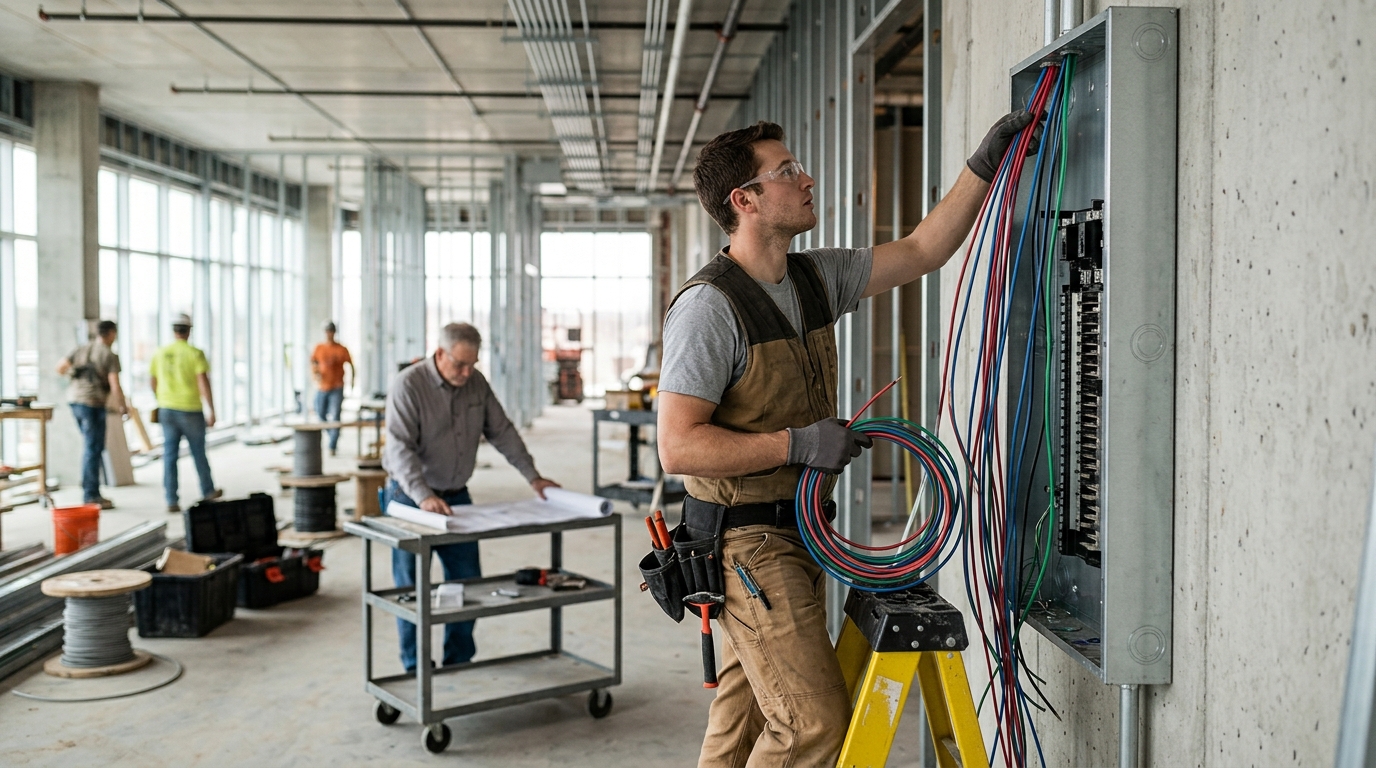
Becoming a licensed electrician usually takes four to five years, because almost every state ties licensing to a set number of supervised on-the-job hours — commonly in the range of 6,000 to 10,000 — plus classroom instruction each year. You can start earning from the first week of an apprenticeship, so the time is spent working, not waiting.
The spread depends on where you live, whether you enter through a registered apprenticeship or accumulate hours under a licensed contractor, and how steadily work comes in. Licensing rules are set state by state, and in some states by the city or county, so check your own licensing board before you plan around any timeline.
What an electrician does
The job is a mix of installation, troubleshooting and paperwork, and the balance shifts with the sector you work in. A residential service electrician spends the day driving between calls; an industrial electrician may spend six months in one plant.
Typical daily tasks:
- Pull and terminate wire — running cable through studs, joists, cable tray or conduit, then stripping, landing and torquing conductors to the manufacturer's specification.
- Bend and install conduit, using a hand bender for small EMT and a mechanical or hydraulic bender for larger rigid runs, then securing and grounding the raceway.
- Install and connect devices and equipment: receptacles, switches, luminaires, panels, disconnects, motors, controls and low-voltage systems.
- Troubleshoot dead circuits and nuisance trips with a multimeter, clamp meter and non-contact tester — tracing a fault back from the symptom to the loose neutral or failed breaker.
- Read and work from drawings: floor plans, panel schedules, one-line diagrams and equipment submittals, flagging conflicts with the general contractor before you cut anything.
- Check work against code — looking up box fill, conductor ampacity or working clearances in the National Electrical Code (NFPA 70) and your local amendments.
- Handle documentation: as-built redlines, material requisitions, daily time and, as an apprentice, your signed hour log.
Where you work: new construction sites, occupied homes and businesses, hospitals, data centers, factories, utility yards and solar arrays. Expect ladders, lifts, attics, crawlspaces, trenches and unconditioned buildings.
Schedule: most construction electricians work roughly 6:30 or 7:00 a.m. to 3:30 p.m., Monday to Friday, with overtime common when a job is behind or a shutdown is scheduled. Service and maintenance roles often include on-call rotations, nights or weekends. Apprentices usually add classroom sessions in the evening or on a day release, on top of a full work week.
The honest downside: the work is physically hard on knees, shoulders and hands, construction work can stop between projects or slow in winter, and travel to out-of-town jobs is normal in some markets.
How to become one
- Finish high school or earn a GED, and take algebra. Most registered apprenticeships require a diploma or equivalent and a passing grade in a year of algebra. If you need the GED, allow 2 to 6 months of study; test fees vary by state and are often around the price of a tank of fuel per subject, with free prep available through many public libraries.
- Find registered apprenticeships near you using the US Department of Labor's apprenticeship finder at apprenticeship.gov. Allow a week of searching and a phone call to each program's training coordinator to ask when applications open — many take applications only once or twice a year. No cost beyond an application fee, which is usually modest or waived.
- Sit the apprenticeship aptitude test and interview. The test typically covers algebra, functions and reading comprehension; the interview panel asks about reliability, safety and why you want the trade. Prep takes 2 to 8 weeks using a math workbook or free practice tests. Expect several weeks to several months between the test and an offer, and be prepared to reapply.
- Consider a pre-apprenticeship or community college electrical program if you are not placed first time. These run 3 to 12 months and can cost anywhere from a few hundred dollars at a community college with in-district tuition to five figures at a private trade school. Some states let a portion of classroom hours count toward licensing hours — confirm with your licensing board before you pay anyone.
- Register your apprenticeship and start logging hours with a licensed supervising electrician. This is the long part: commonly 8,000 supervised hours over four to five years, with a few states using 6,000 and others closer to 10,000, plus roughly 144 hours of related classroom instruction per year. Classroom fees and books typically run a few hundred dollars a year in a sponsored program; some sponsors cover them.
- Get your safety and first aid cards early. An OSHA 10-hour card takes one day and an OSHA 30-hour card takes four; online providers usually charge somewhere between the cost of a work shirt and a decent power tool. Add CPR and first aid, and NFPA 70E arc flash training if you will work on energized equipment.
- Buy a starter tool kit and add to it each year. Day one essentials are linesman pliers, side cutters, strippers, an 11-in-1 screwdriver, a torpedo level, a tape measure, a voltage tester and a multimeter — budget a few hundred dollars, more if your employer does not supply a hand bender or torque screwdriver.
- Apply to your state or local board for the journeyman exam. You submit signed hour affidavits, proof of classroom hours and an application; fees are typically tens to a couple of hundred dollars, and exam prep courses add more. Most exams are open-book on the NEC, so buy the code edition your jurisdiction has adopted and tab it. Allow 1 to 3 months between applying and sitting the exam.
- Decide later whether to pursue a master electrician or contractor license. Most states require two to four years of documented journeyman experience first, then a harder exam covering code, calculations and business law, plus a bond and insurance if you will pull permits. Rules differ sharply by state and sometimes by city — ask the licensing board directly, not a forum.
Skills you'll need
Hard skills
- Code lookup and application. You need to find the right article in NFPA 70 fast — conductor ampacity, box fill, grounding and bonding, working space — and know which local amendments apply.
- Conduit bending and layout. Offsets, saddles and 90s in EMT with a hand bender, and larger runs with a mechanical or hydraulic bender. This is the skill that visibly separates a second-year apprentice from a fourth-year one.
- Metering and troubleshooting. Confident use of a digital multimeter and clamp meter, plus a megohmmeter for insulation resistance testing on motors and feeders.
- Print reading. Floor plans, risers, panel schedules, one-line diagrams and control schematics, including matching submittals to what is actually in the box on site.
- Terminations and torque. Landing conductors, crimping lugs and torquing to the label value with a calibrated torque screwdriver or wrench — a common inspection failure point.
- A specialty, once you have the basics: motor controls and PLC I/O, fire alarm, structured cabling, solar PV and battery storage, or medium-voltage termination.
Soft skills
- Reliability. Show it by arriving before the start time every day for a year; apprenticeship committees and foremen talk, and attendance records follow you.
- Clear communication. Show it by telling your foreman about a conflict or a missing part the moment you find it, with the drawing sheet number, rather than working around it quietly.
- Problem decomposition. Show it by narrating a troubleshooting call in order — symptom, what you tested, what you ruled out, what you found — in an interview or a daily report.
- Safety discipline. Show it by locking out and verifying dead every time, and by being the person who stops a task rather than improvising a ladder.
- Teaching. Show it by walking a newer apprentice through a bend or a panel layout; senior roles are mostly about getting work out of other people correctly.
Pay and outlook
Electricians are generally paid an hourly wage rather than a salary, with overtime after 40 hours in a week under federal rules and sometimes after 8 hours in a day under state rules or a collective agreement. Apprentices typically start at a set percentage of the local journeyman rate and step up at defined intervals — usually every six months or 1,000 hours — as they pass classroom terms and accumulate hours. That structure is why the apprenticeship is worth mapping out: the raises are scheduled, not negotiated.
What moves the number most:
- License level. Apprentice, journeyman, master and contractor are distinct rungs, and each one changes what you can be billed out at.
- Union or non-union. Collective agreements set a published scale, plus health and pension contributions; non-union shops negotiate individually and vary much more.
- Region. Rates track local cost of living and local construction activity, and can differ substantially between metro areas in the same state.
- Sector. Residential service, commercial build-out, industrial maintenance, utility and data center work all pay differently and have different hour patterns.
- Hours and conditions. Overtime, shift differentials, shutdown work, per diem for travel jobs and prevailing-wage requirements on publicly funded projects can change annual earnings more than the base rate does.
- Specialty skills. Controls and PLC work, medium voltage, instrumentation and renewables tend to command a premium where there is local demand.
Demand is tied to construction starts, manufacturing investment, grid and data center buildout, and the pace of electrification work in your area — which is why one metro can be short of hands while another has people on the bench. Construction employment is cyclical; plan for the possibility of a layoff between projects, and keep a reserve.
Where to check current numbers: the BLS Occupational Outlook Handbook entry for electricians for national pay and projected employment change; the BLS Occupational Employment and Wage Statistics tables for state and metro figures; your state workforce agency for local data; and, for public projects, the prevailing wage determinations published for your county. For apprenticeship pay specifically, ask the program sponsor for the current wage progression schedule in writing.
Career path
| Stage | Typical titles | Usual time at this stage |
|---|---|---|
| Entry | Helper, material handler, pre-apprentice, first-year apprentice | 0–1 year before an apprenticeship slot, then year 1 of the program |
| Apprentice | Second-, third-, fourth-year apprentice | 4–5 years total, tracked in hours rather than calendar time |
| Licensed | Journeyman electrician, service technician | 2–5 years before taking on crew responsibility |
| Lead | Lead electrician, foreman | 2–5 years, running a crew of 3–15 on one job |
| Senior | General foreman, superintendent, master electrician | 10–15 years in, overseeing multiple crews or holding the license a company pulls permits under |
| Owner or specialist | Electrical contractor, estimator, project manager, controls technician, electrical inspector, apprenticeship instructor | 12 years and up, or earlier for specialist tracks |
A few things worth knowing about the shape of this path:
- Hours, not years, are what count. If work is slow or you change employers mid-program, your completion date moves with your logged hours.
- Moving states can cost you time. Some states have reciprocity agreements for journeyman licenses; others require you to sit their exam or re-document hours. Check with the destination board before you move.
- Not everyone wants a crew. Service work, industrial maintenance and controls are long-term technical careers that pay well without supervising anyone.
- The exits are real. Inspection, estimating, teaching and utility work all draw experienced electricians, and they are easier on the body in your fifties and sixties.
Frequently asked questions
Do you need a college degree to become an electrician?
No. The standard route is a high school diploma or GED followed by a registered apprenticeship, and most states license on documented hours plus an exam rather than on a degree. An associate degree or certificate in electrical technology can strengthen an apprenticeship application and, in some states, counts toward a portion of required classroom or on-the-job hours — but only if your licensing board accepts that program, so confirm before enrolling.
Can any of this be done remotely?
The installation and troubleshooting work cannot be. The classroom portion of many apprenticeships is now delivered online or in a hybrid format, and code update and exam prep courses are widely available remotely. Related desk roles — estimating, project management, design and plan review — do allow partial remote work, but they are usually reached after years in the field.
How long does it take if I'm switching careers in my thirties or forties?
The same four to five years, because the hour requirements do not change with age. What can change is the route: some career changers go straight to a non-union contractor as a helper and accumulate hours under a licensed electrician where state rules allow it, which avoids waiting for an annual apprenticeship intake. Ask your state board exactly whose supervision counts and what documentation they will accept at exam time, before you take the job.
Is there a faster route to a license?
Only at the margins. A few states have lower hour requirements, some give credit for approved schooling or military electrical experience, and steady overtime fills the hour log faster than a 40-hour week. There is no legitimate path that skips the supervised hours, and any program promising one is worth checking against your licensing board's own list of approved routes.
What if I apply to an apprenticeship and don't get in?
That is common, and reapplying is normal. In the meantime, take a pre-apprenticeship or community college electrical course, get your OSHA 10 card, and look for helper or material-handling work with a licensed contractor so you have relevant experience and a reference on the next application. Ask the program's training coordinator what specifically would make your file stronger next cycle, and write it down.