How Long Does It Take to Become a Dental Hygienist?
From prerequisite classes to a state license, here is the realistic timeline, the exams standing in the way, and what stretches two years into four.
By Olu Adeyemi · Oct 15, 2026 · 13 min read
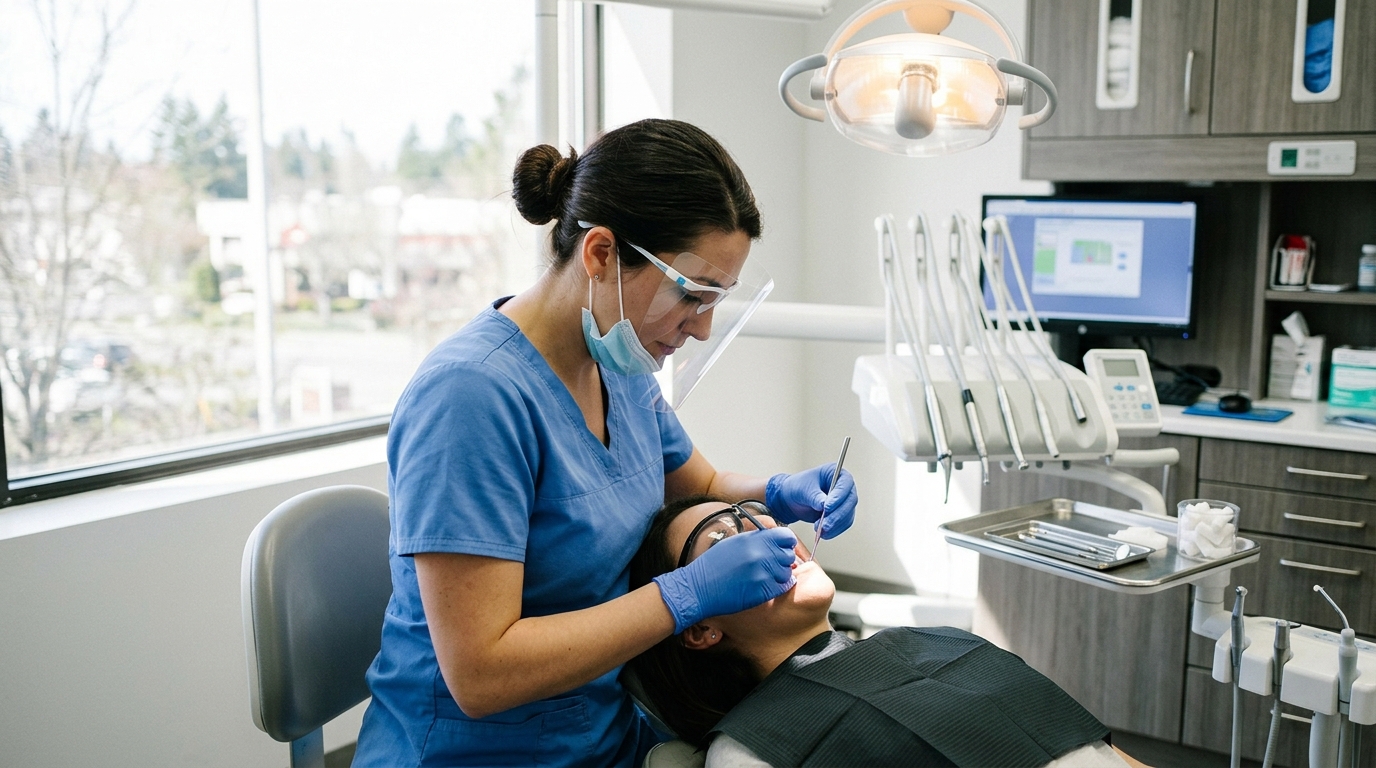
Most people qualify as a dental hygienist in two to four years. The core requirement is an associate degree in dental hygiene from a program accredited by the Commission on Dental Accreditation (CODA), which usually runs about two academic years full time, followed by a written national board exam, a clinical licensure exam and a state license application.
The spread comes from prerequisites and admissions. Many applicants spend a year or more finishing anatomy, chemistry and microbiology before they can apply, and competitive programs admit one cohort a year, so a missed application cycle adds twelve months.
What a Dental Hygienist does
A dental hygienist is a licensed clinician who treats patients directly, usually in their own operatory, with the dentist checking in for exams and diagnosis. The work is hands-on, repetitive in the best sense, and done on a tight appointment schedule.
A typical day includes:
- Reviewing medical histories and taking blood pressure before treatment, and flagging anything that changes the plan — new medications, uncontrolled diabetes, recent heart surgery.
- Removing plaque and calculus with hand instruments (scalers, curettes) and ultrasonic scalers, then polishing and flossing.
- Taking and reviewing radiographs with digital sensors or panoramic units, and mounting them in the patient record.
- Charting periodontal pocket depths, recession and bleeding points, and comparing them to the last visit to see whether the disease is progressing.
- Applying preventive treatments such as fluoride varnish and sealants, and in some states administering local anesthesia or placing temporary restorations where the state practice act allows it.
- Screening for oral cancer, tooth wear, dry mouth and signs of grinding, and passing findings to the dentist.
- Teaching technique at the chair — brushing angle, interdental brushes, how to care for implants or orthodontic appliances — and documenting what you told the patient.
- Sterilizing instruments, turning over the operatory between patients, and keeping notes in practice management software.
Where you work: general dental practices make up most jobs. Others work in periodontal, pediatric or orthodontic specialty offices, community health centers, school-based sealant programs, prisons and correctional health, hospitals, nursing facilities, dental schools, and public health departments. A smaller group works in research, dental product sales and insurance claim review.
Schedule: private practice hygiene is often built around 40- to 60-minute appointments, eight or so patients a day, with many hygienists working three or four days a week rather than five. Some offices open early or run evening and Saturday hours. Part-time and per-diem work is common, and some hygienists build a full week out of two or three offices. Public health and hospital roles are more likely to be standard weekday hours.
How to become one
- Check your state's requirements first on the board of dentistry website for the state where you intend to practice. Every US state licenses dental hygienists, but the details differ: which clinical exam they accept, whether local anesthesia or nitrous oxide administration is permitted, and what continuing education you will owe later. Allow an evening. No cost. Write down the exam names your state accepts before you choose a program.
- Finish prerequisite coursework at a community college or university — typically anatomy and physiology, microbiology, chemistry, English composition, psychology and sociology. Expect two to four semesters if you are starting fresh, less if you already hold college credit. Costs vary enormously between in-district community college tuition and a private university, so price it from the published per-credit rate at the specific school. Many programs also require a minimum grade, often a C or better, in each science course.
- Apply to a CODA-accredited dental hygiene program. Accreditation is not optional — graduating from a non-accredited program will leave you unable to sit the national board or get licensed. Application season usually runs months ahead of a single fall start, and admission is competitive, with points for grades, prerequisite GPA, observation hours and sometimes an entrance test. Budget a few hundred dollars for application fees, transcripts and testing. Allow one to twelve months of waiting, depending on where you land in the cycle.
- Complete the associate degree, usually about two academic years of full-time study with a heavy clinical load — you will treat real patients in a college clinic from the first year, and you are often responsible for recruiting some of them. Total program cost ranges widely: a public community college program is at the low end, a private college or a four-year bachelor's program at the high end, and instruments, loupes, uniforms, immunizations and board exam fees add several thousand dollars on top. Ask the program for its published cost-of-attendance sheet, including the instrument kit.
- Pass the National Board Dental Hygiene Examination (NBDHE), the written exam most states require. Students normally sit it in the final year of the program. Budget four to eight weeks of focused study alongside clinic, and the current fee as published by the Joint Commission on National Dental Examinations.
- Pass a clinical board examination accepted by your state — regional testing agencies such as CDCA-WREB-CRDTS administer most of them, and the format may be patient-based, manikin-based or a mix. Scheduling usually happens near graduation and the fee runs to several hundred to over a thousand dollars. Failing one section is survivable; you retake it, which can push your start date back a month or two.
- Apply for your state license and add required certifications. Most boards want fingerprinting and a background check, a jurisprudence exam on state law, and current CPR/Basic Life Support (BLS) certification from a provider such as the American Heart Association. Processing often takes two to eight weeks, so apply the moment you are eligible. If your state permits it, add a local anesthesia permit — some programs build it in, others require a separate course.
- Line up your first position while your license is pending. Tell your clinical instructors and the dentists who supervised you that you are looking; temp and per-diem agencies are a common way into private practice and let you see several offices before committing. Expect a working interview where you scale an actual patient while the dentist watches.
What goes wrong. The two most common delays are prerequisites taken out of order and missing a single annual admissions cycle. Programs are small, waitlists are real, and a 2.8 GPA in the sciences will not clear most of them. The second honest problem is the body: scaling is repetitive, static and done in awkward postures, and hygienists are prone to neck, shoulder, wrist and back injuries. Buy proper loupes, learn ergonomics early, and treat it as a career-length issue rather than a beginner's problem.
Skills you'll need
Hard skills
- Instrumentation. Sharpened hand scalers and curettes, ultrasonic and piezo scalers, air polishing. You are judged on whether the tooth is actually clean subgingivally and whether the patient's tissue survived the appointment.
- Radiography. Positioning with digital sensors and holders, panoramic and bitewing series, exposure settings and retakes, plus the radiation safety rules your state enforces.
- Periodontal assessment and charting. Six-point probing, recording recession, furcation and mobility, and reading the chart over time to tell a patient why they are moving from a routine cleaning to scaling and root planing.
- Clinical documentation and software. Practice management systems such as Dentrix, Eaglesoft or Open Dental for notes, recall scheduling and treatment codes. Accurate notes protect you and determine whether the office is paid.
- Infection control and sterilization. Autoclave cycles and spore testing, instrument cassettes, surface barriers, PPE — against CDC infection prevention guidance and your state's rules.
- Preventive and, where permitted, expanded functions. Sealants, fluoride varnish, silver diamine fluoride, and in states that allow it, local anesthesia, nitrous oxide monitoring or temporary restorations.
Soft skills
- Patient education that lands. Show it by explaining one finding in plain language and one change the patient will actually make — not a lecture on flossing. In an interview, describe how you talked a specific patient through a periodontal diagnosis.
- Pace and time management. You have a fixed appointment length and the next patient is already in the waiting room. Show it by describing how you handle a heavy-calculus patient who needs ninety minutes in a sixty-minute slot.
- Handling anxious and resistant people. Show it with an example of a patient who had avoided the dentist for years and came back for a second visit.
- Working under a dentist's supervision. You diagnose nothing officially; you present findings and the dentist decides. Show it by describing how you raise a disagreement about a treatment plan privately and factually.
- Physical self-management. Show it by naming your ergonomic habits: loupes with the right declination, patient positioning, alternating hands, stretching between patients.
Pay and outlook
Dental hygiene pay is usually structured by the hour or by the day, and in some offices by a daily guarantee plus a percentage of production. Because so many hygienists work three or four days a week by choice, annual earnings vary far more than hourly rates do, and comparing two hygienists' incomes without knowing their days worked tells you nothing.
What moves the rate:
- Geography. State and metro area are the biggest single factor. Rates in high-cost coastal metros and rates in rural inland counties are not in the same range, though cost of living absorbs some of the difference. Rural and underserved areas sometimes pay a premium because they struggle to fill chairs.
- Setting. Private general and specialty practices, corporate dental groups, community health centers, schools and correctional facilities all pay differently and offer very different benefits. Public health and government roles tend to trade rate for paid leave, retirement and predictable hours.
- Days and schedule. Full-time, part-time and per-diem work are all normal. Temping typically carries a higher day rate with no benefits at all.
- Permits and scope. States that allow hygienists to administer local anesthesia, place restorations, or practice under collaborative or direct-access arrangements create roles that pay above a basic prophylaxis-only position.
- Benefits. Whether the office provides health insurance, paid time off, retirement matching and continuing education reimbursement often matters more than the headline hourly figure, and many part-time hygiene positions include none of it.
Demand is tied to the number of dental practices in your area, how many programs graduate hygienists nearby, and whether the local population has dental coverage. States differ in what hygienists may do without a dentist physically present, and those scope-of-practice rules shape how many jobs exist outside private offices.
For current national and state-by-state pay and employment projections, check the dental hygienists entry in the US Bureau of Labor Statistics Occupational Outlook Handbook and the BLS Occupational Employment and Wage Statistics tables, which break figures down by state and metro area. Your state dental hygienists' association and local temp agencies are the best source for what offices in your city are actually paying this year.
Career path
Clinical dental hygiene is a flat career. Most hygienists spend decades in the same job title and build earnings through rate negotiation, extra permits and choosing their setting, not promotions. The moves that exist usually require more education or a step away from the chair.
| Stage | Typical titles | Years |
|---|---|---|
| Entry | Registered Dental Hygienist (RDH), temp or per-diem hygienist | 0-2 |
| Mid | Experienced RDH, lead hygienist, hygiene coordinator, public health hygienist, school sealant program hygienist | 2-7 |
| Senior | Hygiene department manager in a multi-site group, clinical instructor, program faculty, corporate clinical trainer, dental product specialist, public health program coordinator | 7+ |
What happens at each stage:
- Years 0-2. You are building speed. New graduates are clinically sound but slow, and the first year is mostly about fitting good care into the appointment length. Temping across several offices here is a fast way to learn different systems and find a practice you want to stay in.
- Years 2-7. You negotiate rate seriously for the first time, add permits your state allows, and decide whether private practice, community health or a specialty office suits you. Some hygienists start a bachelor's degree completion program part time at this point — it is the gateway to teaching, public health and administrative roles.
- Years 7 and beyond. Options open up if you have the degree. Community college programs hire clinical instructors, often part time alongside clinical days. Multi-site groups hire hygiene managers to standardize protocols and mentor new graduates. Public health departments run sealant and access programs. Manufacturers hire hygienists as educators and territory specialists. A master's degree leads to program director and research roles; a few states license dental therapists, a mid-level provider role with a separate education pathway.
The honest limit: if you want to diagnose and restore, that is dentistry, and it means dental school — four more years after a bachelor's degree, with its own admissions test and cost. Plenty of hygienists make that jump, but it is a restart, not a promotion.
Frequently asked questions
Do I need a bachelor's degree to be a dental hygienist?
No. An associate degree from a CODA-accredited dental hygiene program is the standard entry credential for clinical practice in every US state, and it is what most hygienists hold. A bachelor's degree becomes necessary if you want to teach in a hygiene program, move into public health administration, work in research or industry, or go on to a master's. Some people earn the associate degree, start working, then finish a degree completion program part time while employed.
How long does it take in total if I'm starting from zero college credit?
Plan on three to four years. That is roughly one to two years of prerequisite science and general education courses, two years in the dental hygiene program itself, and then one to three months for board exams and license processing. If you already have college credit that satisfies anatomy, physiology, microbiology and chemistry, you can be close to the two-and-a-half-year end. The biggest unplanned delay is admissions: most programs start one cohort a year, so being turned down or applying late costs a full year.
Can any of this be done remotely?
The clinical work cannot. Scaling, radiographs and patient assessment all happen in person, and licensure requires supervised clinical hours plus a hands-on clinical exam. Some programs deliver lecture courses online and prerequisites are widely available online, but you will be on campus and in a clinic for the rest. Away from the chair, a few roles have remote components — insurance claim review, teledentistry screening in some states, continuing education instruction and some industry positions — but they generally expect clinical experience first.
Can I work while I'm in the program?
Some students do, but less than they expect. Dental hygiene programs are full-time, with lecture, lab and clinic blocks scheduled across the week, plus board exam preparation and patient recruitment in the second year. Students who work usually hold weekend or evening shifts, often as dental assistants, which has the side benefit of familiarity with instruments and software. Ask the program directly how many hours per week their current students manage; faculty will tell you honestly.
Does my license work in another state if I move?
Not automatically. Each state board sets its own requirements, and they differ on which clinical examination they accept, whether they grant licensure by credentials or endorsement to experienced hygienists, and what extra jurisprudence exam or background check applies. Some states participate in interstate compact arrangements; others do not. Before you move, read the licensure-by-endorsement page on the destination state's board of dentistry website and call the board with your specific exam history.